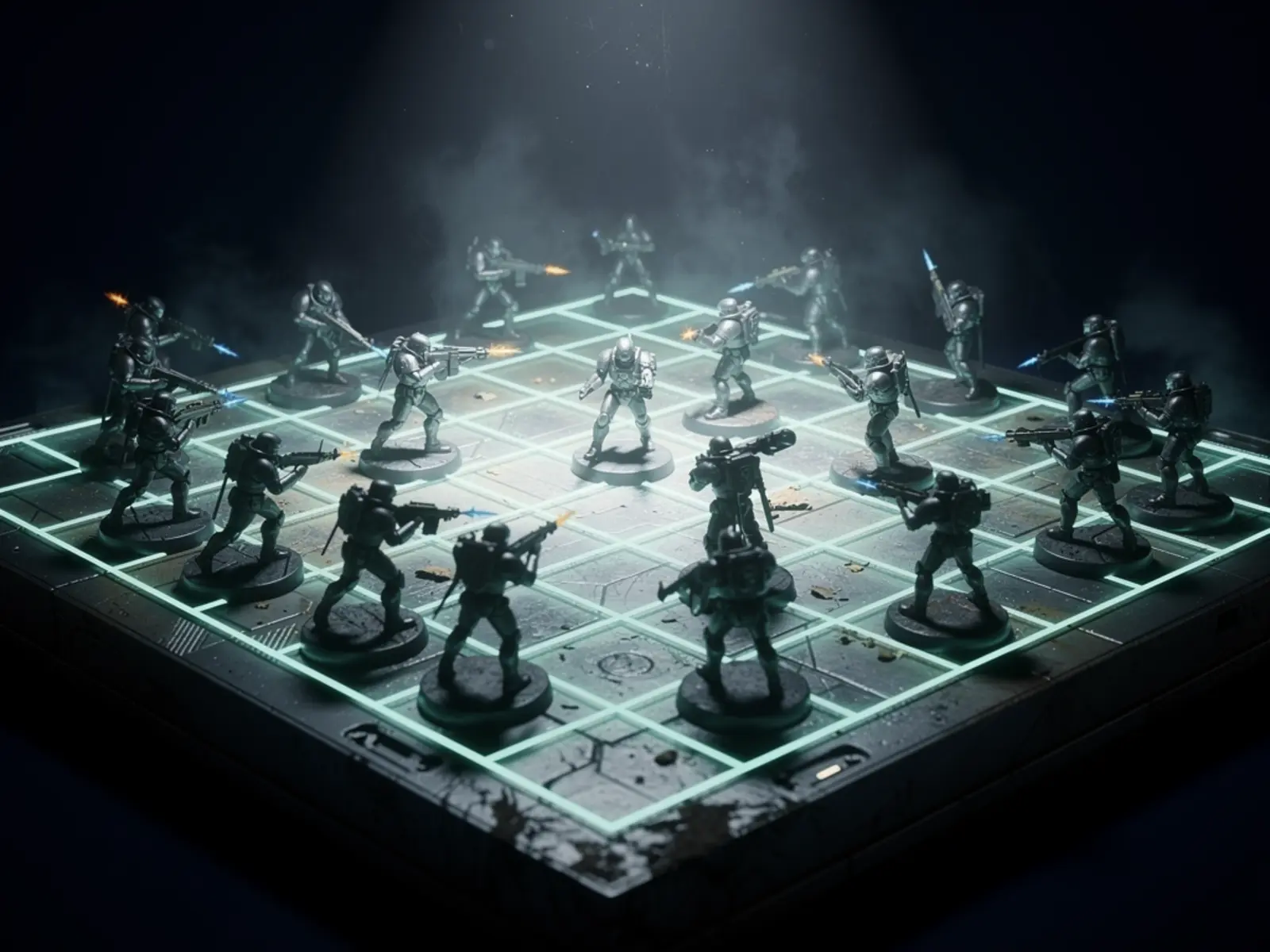
The idea
Prove that an under-table XY carriage can move one miniature accurately without disturbing nearby pieces. V1 is a small removable test surface with passive magnetic bases. Articulated figures, inductive charging, a full table and multi-piece simultaneous movement are later projects with separate risks.
The connection
Tabletop play meets hidden robotics. The central design challenge is making an invisible mechanism move a real piece convincingly, precisely and without disturbing the rest of the board.
How it could work
The hardest interface is magnetic coupling through the tabletop. Build an adjustable-gap test fixture before designing furniture. Test the actual board material and finish, representative piece mass, felt or glide pads and several magnet arrangements. Stronger coupling increases drag and can attract adjacent pieces; it is not automatically better.
Use one XY carriage with homing sensors and a physical way to disengage the magnetic coupling, such as lowering its magnet. Without disengagement, returning the carriage may drag pieces unintentionally. Begin with manually placed obstacles and a known occupancy map. Motor steps locate the carriage, not the miniature; add overhead observation or a recovery workflow to detect slips.
What would prove it
Use a proposed 300 × 300 mm coupon with one moving piece and four stationary pieces. Record 100 routes containing straight moves, diagonals, turns, magnet disengagement and a return-to-home. Repeat with the heaviest intended miniature and with the board slightly contaminated by normal dust.
Proposed gate: at least 95 of 100 routes complete within 3 mm of the target, no stationary piece moves more than 1 mm, and every slip can be recovered without losing the known board state. Treat these as exploratory targets. If they fail, reduce gap, speed or piece mass before buying a larger mechanism.
The path to a complete build
- Characterise magnet force and sliding friction using coupons.
- Demonstrate carriage homing, boundaries and reliable disengagement.
- Add route generation with occupied-cell avoidance; demonstrate rejection of blocked moves.
- Add a calibration grid and measured piece-position feedback.
- Scale only after recording a video and route log with success, errors and recovery actions.
Open the engineering notebook
Components, interfaces and calculations
Required items are a modest XY mechanism, supported stepper controller, power supply, endstops, lift mechanism, test magnets, interchangeable board samples and weighted dummy bases. A camera is useful for measurement but is not initially a required navigation component. Allow access beneath the board for clearing jams.
Measure maximum drag force with a pull gauge. Compare it with available lateral magnetic holding force across the chosen gap. Size clearances from the largest base diameter plus measured tracking error and a margin. A path planner must inflate obstacles by the moving base radius; a clear centreline alone is insufficient.
Scope and development questions
Plan 5–8 sessions for the coupon rig. Price the XY mechanism and lift first; furniture is excluded until coupling passes. Resolve piece mass, base diameters, desired terrain, board thickness and whether a raised obstacle-free transit area is acceptable. The first commercial question is whether automatic movement adds enough value to justify clear-path restrictions during a real game.