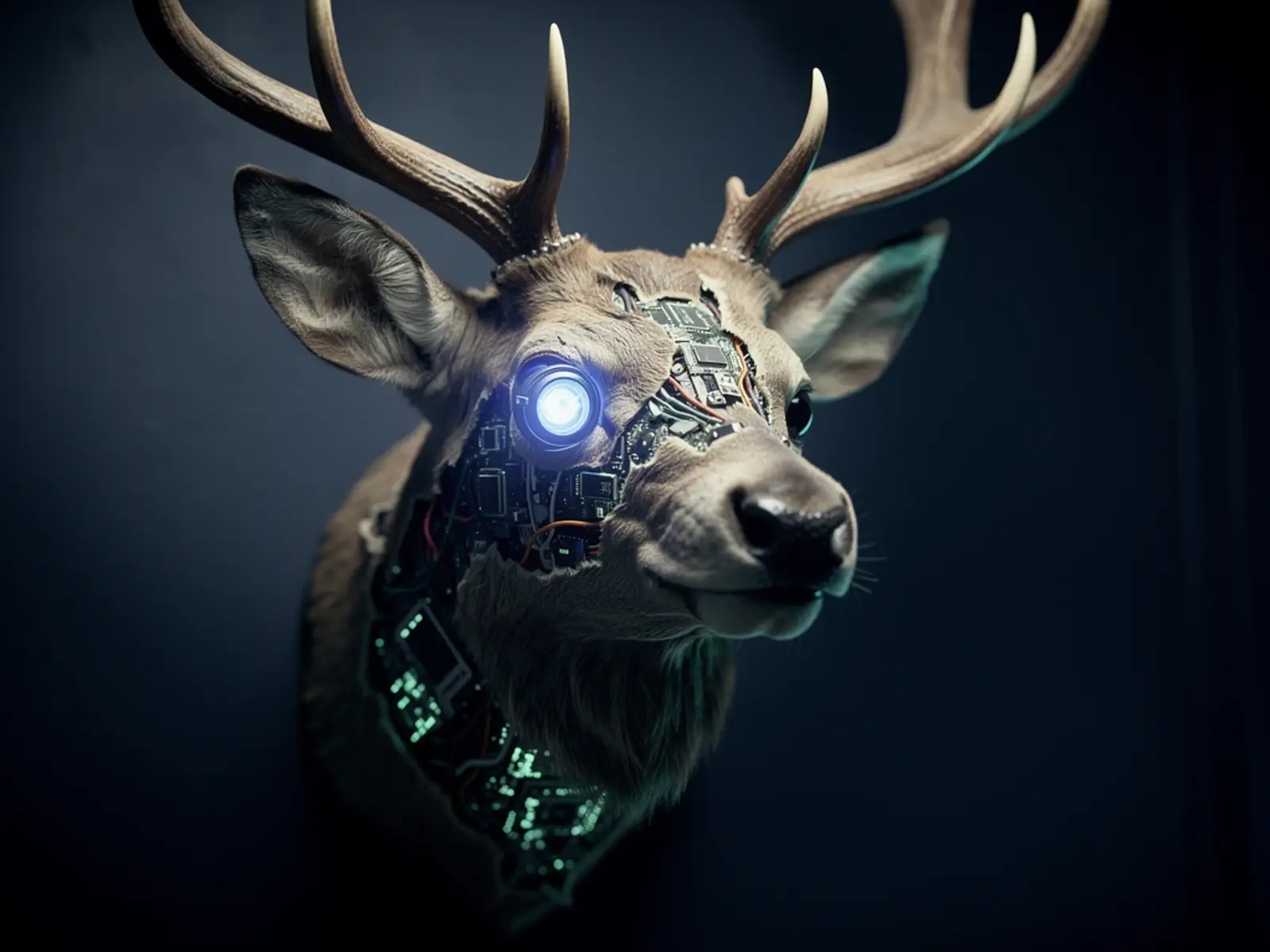
The idea
Make a responsive animatronic character with convincing, limited head and eye motion. V1 uses a replica or removable mechanical mock-up before integration with an existing mount. It responds to a button or simple presence cue, with optional recorded speech. Camera-based interpretation and generative conversation follow only after the mechanism is dependable.
The connection
Sculpture, mechanical gesture and reactive electronics meet here. A small movement can create a strong impression when its timing, range and character have been designed carefully.
How it could work
Design motion around the mount's real clearances and an independent internal frame. Do not make fragile surface material carry actuator loads. Counterbalance the head where possible to reduce continuous servo torque and noise. Restrict travel mechanically and in software, use smooth acceleration and return to a safe idle pose when commands expire.
The ESP32 controls local motion; a separate service can provide higher-level dialogue without directly commanding arbitrary servo positions. Allow only named, bounded gestures. A Seeed XIAO ESP32-S3 Sense is a candidate camera/microphone board, but its actual camera revision, pin availability and power needs must be checked. Servos need an appropriately sized supply rather than power from a small logic-board rail.
What would prove it
Build a single head-axis rig with a weighted dummy and run 200 slow motion cycles. Measure supply dips, temperature, noise and position repeatability. Interrupt higher-level commands, disconnect the network and press stop during motion. Then test a small gesture set with three observers without explanatory narration.
Proposed gate: no binding or collision across the full permitted travel; no unexpected motion at boot; command loss returns to the documented state; the controller does not reset during servo starts; observers consistently recognise the intended gesture. Log any heating or chatter and redesign the mechanism rather than hiding it with software.
The path to a complete build
- Measure the mount and make a removable skeleton and weighted dummy.
- Prove one axis, power separation and safe travel limits.
- Add eyes and timed audio with bounded gesture commands.
- Test cues and visitor interaction with explicit capture indication if cameras are used.
- Integrate only after the mechanism passes; retain service access and a documented removal method.
Open the engineering notebook
Components, interfaces and calculations
Prototype parts include a rigid skeleton, bearings or pivots, linkages, servos, power supply, controller, limit or home sensing where needed, speaker and physical stop. Add a camera only after checking what can actually be seen through the proposed eye opening. Treat conservation and provenance of an existing specimen as a separate owner/specialist decision.
Estimate static joint torque as mass × gravity × distance from pivot to centre of mass, then account for acceleration, friction and a design margin. For example, a 0.3 kg assembly with its centre 50 mm from the pivot creates about 0.147 N·m before those additions. A servo's stall torque is not a continuous operating rating.
Scope and development questions
Allow 5–8 sessions for a one-axis rig, then re-estimate the complete character. Quote actuators by measured load and duty cycle, not merely size. Resolve dimensions, material fragility, acceptable noise and intended public interaction distance before selecting parts. No APX mechanical drawings or tested mount were available for this draft.